
Medicare modifiers play a critical role in accurate medical billing. These two-digit codes explain how, why, or under what circumstances a service was performed. When used correctly, modifiers support medical necessity, clarify complex services, and help ensure proper reimbursement.
However, Medicare modifier mistakes are one of the most common reasons for claim denials, delayed payments, and audits. Errors such as misunderstanding Modifier 51, misusing Modifier 59, or applying unnecessary modifiers can quickly disrupt cash flow and trigger compliance risks.
This guide explains the most common Medicare modifier mistakes, including the 51 modifier description, Modifier 51 vs 59, and errors involving Modifiers 50 and 52, along with clear, practical steps to avoid them.
Understanding Medicare Modifiers
Medicare modifiers are two-character codes appended to CPT or HCPCS codes to describe special circumstances related to a service. They help Medicare determine whether services should be paid separately, reduced, or adjusted.
Common situations that require modifiers include:
- Multiple procedures performed during the same session
- Bilateral services
- Reduced or discontinued services
- Distinct procedures performed on the same day
Medicare applies its own rules for modifiers, which often differ from commercial insurance. That’s why using modifiers correctly, and only when necessary, is essential for compliance and reimbursement.
Top 10 Medicare Modifier Mistakes and How to Avoid Them
1. Misunderstanding the 51 Modifier Description
Modifier 51 indicates multiple procedures performed during the same session. A common mistake is assuming it must always be added manually.
How to avoid it:
Medicare often applies multiple-procedure reductions automatically. Adding Modifier 51 when it’s not required can cause denials or underpayment.
2. Using Modifier 51 When It’s Not Allowed
Modifier 51 should not be used with add-on codes or services that Medicare already excludes from multiple-procedure reductions.
How to avoid it:
Check the Medicare Physician Fee Schedule and National Correct Coding Initiative (NCCI) edits before applying Modifier 51.
3. Confusing Modifier 51 vs 59
One of the most frequent errors is mixing up 51 vs 59 modifier usage.
- Modifier 51 → multiple procedures in the same session
- Modifier 59 → distinct, separate services not normally reported together
How to avoid it:
Use Modifier 59 only when services are truly separate by site, time, encounter, or anatomy, and document clearly.
4. Overusing Modifier 59
Modifier 59 is closely monitored by Medicare because it’s often misused to bypass bundling edits.
How to avoid it:
Only use Modifier 59 when documentation clearly proves services were independent. If another modifier fits better, use that instead.
5. Incorrect Use of Modifier 52 (Reduced Services)
Modifiers 52 are used when a service is partially reduced or discontinued.
How to avoid it:
Document exactly what portion of the service was performed and why it was reduced. Without this, Medicare may deny or downcode the claim.
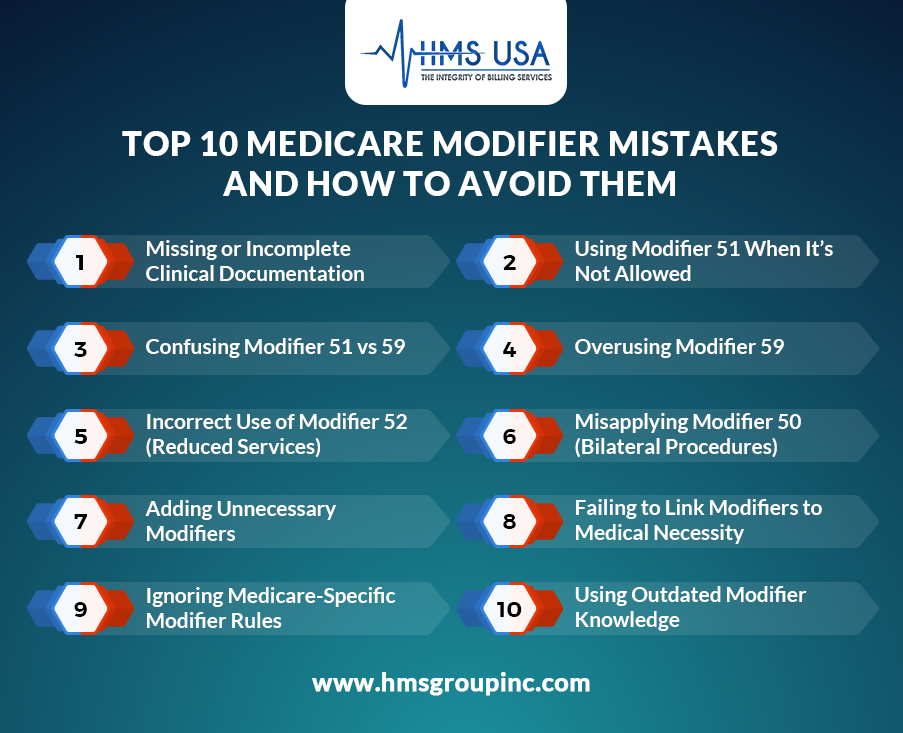
6. Misapplying Modifier 50 (Bilateral Procedures)
Modifiers 50 indicate services performed on both sides of the body, but some procedures are already classified as bilateral.
How to avoid it:
Verify whether Medicare requires Modifier 50 or prefers separate line items with modifiers LT and RT.
7. Adding Unnecessary Modifiers
Using modifiers when Medicare doesn’t require them can trigger rejections or audits.
How to avoid it:
Apply modifiers only when documentation and Medicare rules clearly support their use.
8. Failing to Link Modifiers to Medical Necessity
Even technically correct modifiers can result in denials if medical necessity isn’t clearly documented.
How to avoid it:
Ensure progress notes, operative reports, and diagnoses directly support why the modifier was needed.
9. Ignoring Medicare-Specific Modifier Rules
Medicare rules often differ from commercial payers. Applying non-Medicare logic can lead to compliance issues.
How to avoid it:
Train staff specifically on Medicare modifier guidelines, not general billing practices.
10. Using Outdated Modifier Knowledge
Modifier rules change over time. Outdated practices increase denial risk.
How to avoid it:
Stay current with CPT updates, Medicare manuals, and payer bulletins.
The Role of Documentation in Modifier Accuracy
Modifiers signal that a service was performed under special circumstances, but documentation is what proves it. Operative notes, treatment records, and progress notes must clearly explain:
- What made the service distinct, reduced, or bilateral
- Why were multiple procedures necessary
- How the service met medical necessity
Missing or unclear documentation is one of the top reasons Medicare denies modifier-related claims.
When to Use Modifier 59 Correctly
Modifier 59 should only be used when procedures normally bundled together were truly separate. This may include:
- Different anatomical sites
- Separate encounters on the same day
- Different sessions or time intervals
Never use Modifier 59 simply to override edits. Doing so increases audit and recoupment risk.
Why Accurate Modifier Use Matters for Reimbursement
Incorrect modifier usage leads to:
- Claim denials and payment delays
- Reduced reimbursement
- Increased audit risk
- Administrative rework and staff burnout
Accurate modifier application ensures clean claims, faster payments, and Medicare compliance.
How HMS USA Inc. Helps Prevent Medicare Modifier Mistakes
HMS USA Inc. supports providers with expert Medicare billing and compliance services, including:
- Accurate modifier selection based on Medicare rules
- Pre-submission claim reviews to catch errors early
- Documentation audits to support Modifier 51, Modifier 59, and others
- Ongoing staff training on updated Medicare guidelines
- Faster payments through cleaner, compliant claims
Our Medicare-focused billing experts help providers reduce denials, avoid audits, and protect revenue.
Conclusion
Medicare modifier mistakes often stem from misunderstanding rules, confusing Modifier 51 vs 59, or failing to support modifiers with proper documentation. Errors involving Modifiers 50 and 52 are also common causes of denials and payment reductions.
By applying modifiers carefully, following Medicare-specific guidelines, and maintaining strong documentation, providers can significantly reduce billing errors. Routine audits and expert oversight further protect compliance and reimbursement.
For reliable Medicare billing support and accurate modifier management, HMS USA Inc. helps practices submit cleaner claims, reduce denials, and get paid the first time correctly.
For trusted expert support in Medicare billing, compliance audits, and precise modifier use, choose HMS USA Inc. Our certified billing specialists improve claim accuracy while maximizing compliant reimbursement.
FAQs
What are Medicare modifier mistakes?
They occur when modifiers are used incorrectly, unnecessarily, or without documentation, leading to denials or audits.
What does the 51 modifier mean in Medicare billing?
Modifier 51 indicates multiple procedures in the same session, but Medicare often applies reductions automatically.
What is the difference between Modifier 51 and Modifier 59?
Modifier 51 is for multiple procedures; Modifier 59 is for distinct, separate services.
When should Modifiers 52 and 50 be used?
Modifier 52 is for reduced services; Modifier 50 is for bilateral procedures when Medicare requires it.
How can providers avoid Medicare modifier mistakes?
By following Medicare rules, keeping clear documentation, performing audits, and working with experienced billing experts.