
Podiatry focuses on diagnosing and treating problems related to the foot and ankle. To make sure podiatrists get paid correctly for the care they provide, it’s important to use the right Current Procedural Terminology (CPT) codes. These codes help practices follow insurance rules, avoid claim denials, and keep billing accurate.
Understanding CPT Codes for Podiatry is important because it leads to cleaner claims, better documentation, and stronger financial performance. Even small coding mistakes can cause delays or lost revenue.
This guide explains the most commonly used podiatry CPT codes in simple terms. It also covers important modifiers, documentation requirements, and practical billing tips to help your practice run smoothly and efficiently.
Understanding CPT Codes for Podiatry
CPT coding is a key part of podiatry billing. These codes describe the services and treatments podiatrists provide, which helps insurance companies understand the claim and pay correctly. Every CPT code represents a specific service, from basic foot care to advanced procedures.
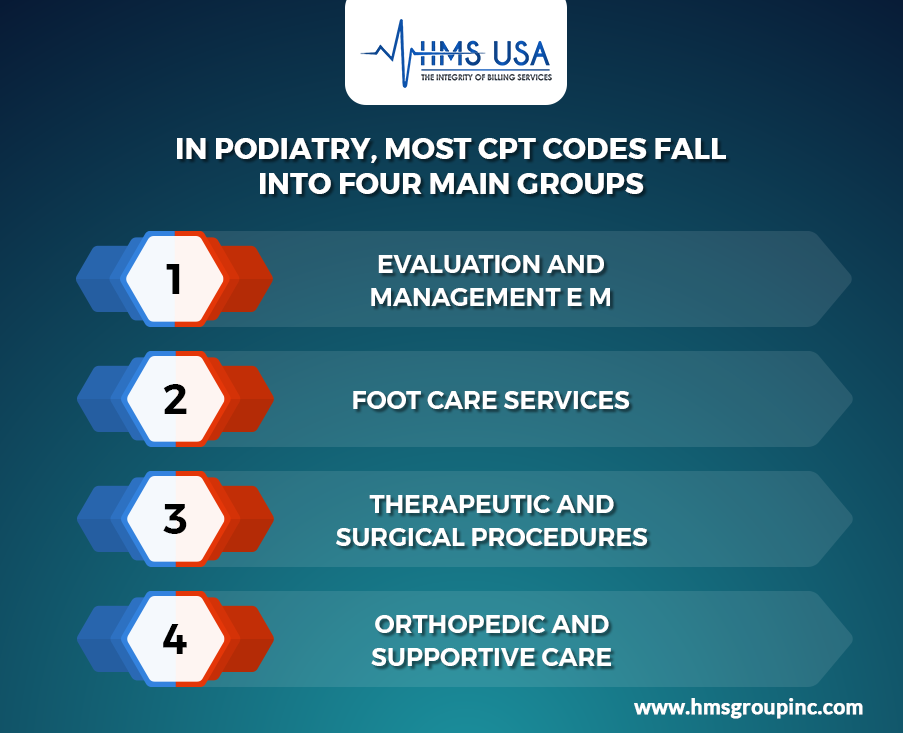
In podiatry, most CPT codes fall into four main groups:
- Evaluation and Management (E/M): Patient exams, consultations, and follow-up visits.
- Foot Care Services: Nail trimming, callus removal, and routine care for patients with medical risks.
- Therapeutic and Surgical Procedures: Injections, lesion removal, wound care, and surgical treatments.
- Orthopedic and Supportive Care: Strapping, orthotics, and applying casts or splints.
Using the right CPT code helps prevent claim denials, supports proper payment, and keeps your practice compliant with insurance rules.
Common CPT Codes for Podiatry
Podiatrists perform many types of services, and some CPT codes are used more often than others.
Below are the main categories and commonly used codes in podiatry, along with expected updates for 2026.
- Debridement Codes
These codes are used when removing dead or infected tissue to help wounds heal.
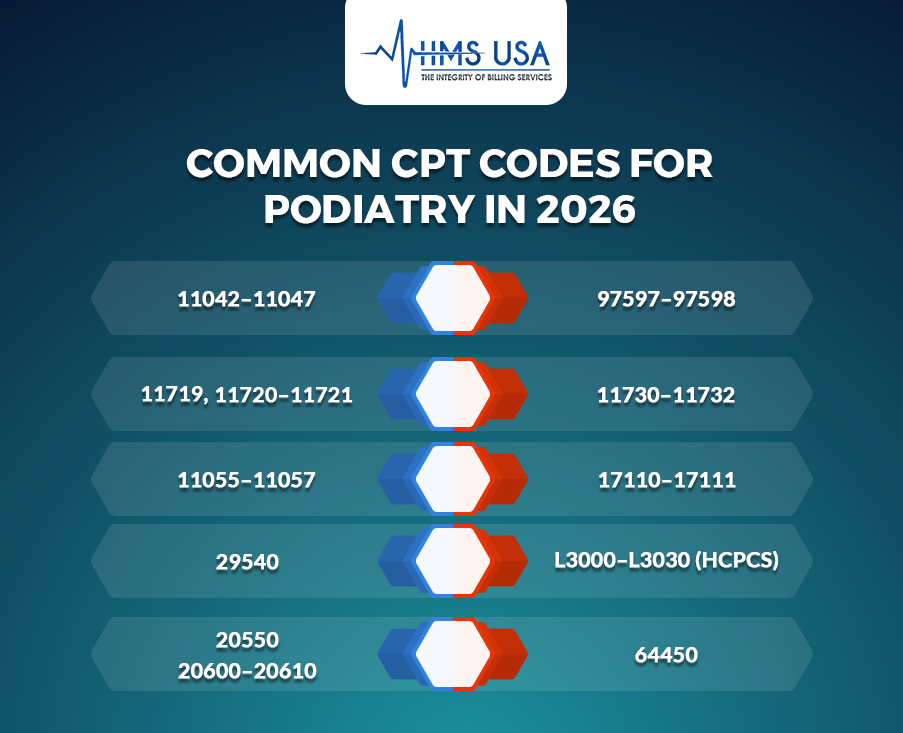
- 11042–11047: Debridement based on how deep and large the wound is.
- 97597–97598: Selective debridement for chronic wounds or ulcers.
The documentation must clearly describe the wound depth and size to avoid claim issues.
- Nail Care Codes
These codes apply to thick, fungal, or ingrown nails.
- 11719: Trimming normal (nondystrophic) nails.
- 11720–11721: Debridement of thick or fungal nails.
- 11730–11732: Removing part or all of a nail.
Medical necessity must be documented, especially for Medicare patients.
- Lesion Removal Codes
Used when removing corns, calluses, or other benign lesions.
- 11055–11057: Paring or cutting of corns and calluses.
- 17110–17111: Destruction of benign lesions (e.g., freezing or chemical treatment).
The right code depends on how many lesions were treated and the method used.
- Strapping and Orthopedic Care
These codes cover treatments that support or stabilize the foot.
- 29540: Strapping of the foot or ankle.
- L3000–L3030 (HCPCS): Orthotic inserts or supportive devices.
Documentation should explain why the support was needed.
- Injections and Therapeutic Procedures
These are common for pain, inflammation, and nerve-related conditions.
- 20550: Injection into a tendon sheath or ligament.
- 20600–20610: Injections into a joint or bursa, depending on size and location.
- 64450: Nerve block injection for pain relief.
The correct code depends on the type of injection and the exact location.
CPT Code for Podiatry Evaluation and Treatment – 2026 Coding Updates
Evaluation and Management (E/M) codes are used to describe podiatry checkups and follow-up visits. These codes show how complex the visit was and how much time the podiatrist spent with the patient. Choosing the right E/M code helps ensure accurate payment and reduces billing problems.
Common Podiatry Exam Codes (99202–99215)
99202–99205: Used for new patients. These visits need more detailed documentation because the podiatrist is seeing the patient for the first time.
99212–99215: Used for established patients. These visits usually require less documentation because the podiatrist already knows the patient’s history.
These codes are used for common visits like foot pain checks, diabetic foot exams, follow-ups for chronic problems, and pre-surgery evaluations.
New vs. Established Patients
- A new patient is someone who has not seen the podiatrist (or another podiatrist in the same practice) in the last 3 years.
- An established patient has been seen within the last 3 years.
- New patient visits take more time and documentation, which is why their codes have higher reimbursement.
Documentation Requirements
To choose the correct E/M code, podiatrists should document:
- Why the patient came in
- Relevant medical history
- Clear physical exam findings
- Diagnosis and treatment plan
- Total time spent (when coding based on time)
Good documentation helps ensure accurate coding, prevents claim denials, and reduces audit risk.
Procedure-Specific CPT Codes Podiatry
Podiatry includes many types of tests, treatments, and surgeries for the feet and ankles. Using the right CPT codes helps podiatrists bill correctly and receive proper payment.
Below are the main types of procedures and the codes often used.
Foot and Ankle X-Rays
Podiatrists use X-rays to check for broken bones, deformities, and other foot or ankle problems.
- 73620–73630: Foot X-rays
- 73600–73610: Ankle X-rays
These codes depend on how many X-ray views are taken and which area is being checked.
Orthotic Casting & Fitting
Orthotics (custom or prefabricated shoe inserts) help correct foot alignment and reduce pain.
- 29799: Unlisted casting or strapping
- L3000–L3030 (HCPCS): Custom or prefabricated foot orthotics
The provider must explain how the casting was done and why the orthotic is needed.
Wound Care Codes
Podiatrists often treat foot wounds such as diabetic ulcers or pressure sores.
- 11042–11047: Debridement (removing damaged tissue)
- 97597–97598: Wound assessment and selective debridement
- 15275–15278: Applying skin substitutes
Correct coding depends on how deep the wound is, its size, and the type of care provided.
Surgical Procedure Codes
Podiatric surgery can be simple or complex, depending on the condition being treated.
- 11730–11732: Removing part or all of a toenail
- 28285: Correcting a hammertoe
- 28300–28315: Bone-cutting procedures (osteotomies)
- 27650–27654: Achilles tendon repair
- 28100–28124: Removing bone growths or lesions
Surgeries must be supported with clear notes describing what was done and why.
Biomechanical Exams
These exams help identify how a person walks and how their feet move.
- 97750: Testing strength, motion, and function
- 98925–98929: Hands-on manipulative treatment (used in some podiatry clinics)
Notes should include measurements, exam findings, and a reason for the exam.
Using Modifiers in Podiatry Billing
Modifiers are small codes added to medical billing to give extra information about a service. They help insurance companies understand exactly what was done, making sure providers get paid correctly and claims aren’t rejected.
Common Modifiers For Podiatry
- Modifier 25 – Used when a patient has a separate exam or consultation on the same day as a procedure.
- Modifier 59 – Shows that two procedures are separate and not normally billed together.
- Modifiers Q7, Q8, Q9 – Used for routine foot care, based on the patient’s health, like poor circulation or loss of feeling in the feet.
- RT / LT – Shows whether a procedure was done on the right or left foot.
- Modifier 51 – Used when more than one procedure is done in the same visit.
- Modifier 79 – For a procedure that is unrelated to a previous surgery, done during the recovery period.
How to Use Modifiers Correctly
- 25 – Use when the exam is separate from a minor procedure.
- 59 – Used to separate procedures in different areas or for different problems.
- Q7–Q9 – Only for patients who meet specific medical requirements.
- RT/LT – Always include procedures on just one foot.
- 51 – Use when multiple procedures are needed in one visit.
- 79 – Use for unrelated procedures during the post-surgery period.
If your practice is struggling with claim denials, modifier confusion, or delayed payments, it might be time to get expert support.
At HMS USA Inc, we help podiatry practices simplify billing, reduce errors, and maximize collections without adding extra workload to your team.
Want to see how much revenue you’re leaving on the table? Let’s review your billing process.
Podiatry Billing Codes – Documentation and Compliance Tips
Successful podiatry billing depends on accurate documentation and following the rules. Medicare and other payers carefully review foot care claims because routine services are common, and medical necessity must be clearly proven.
The Importance of Detailed Documentation
Good documentation helps ensure correct payments and keeps billing compliant. Podiatrists should note the patient’s history, symptoms, foot condition, and details of any procedures (which foot and how many lesions).
They should also explain why the treatment is needed and include the right diagnostic codes. Clear records help us use the correct CPT codes and modifiers.

Common Billing Errors and How to Avoid Them
Errors in podiatry billing can delay payments or lead to denials. Common mistakes include incorrect use of modifiers like 25 and 59, missing documentation for routine foot care exceptions, confusing new and established patient codes, billing services that are not covered as medically necessary, and incorrect right or left coding.
These errors can be avoided with thorough documentation, proper staff training, and regular internal audits.
Routine Foot Care vs. Medically Necessary Care
Routine foot care, such as nail trimming, callus removal, and hygiene, is generally not covered by Medicare unless the patient has specific health risks like diabetes, neuropathy, arthritis, or poor circulation.
Moreover, Coverage also requires supporting Q7–Q9 findings and evidence that skipping care could cause serious problems. Services such as nail debridement, ulcer care, or treatment for qualifying conditions are considered medically necessary and must be fully documented to justify coverage.
Medicare Guidelines for Podiatry
- Only bill routine foot care for patients who qualify under Medicare rules.
- Always use the correct modifiers on claims.
- Record the patient’s clinical findings at every visit.
- Make sure procedures billed match the notes.
- Note if the patient cannot do foot care themselves
- Follow limits on how often services like nail care can be done.
- Link each procedure to its proper diagnosis.
- Stick to these rules to avoid denials and audits.
2026 Coding Updates For Podiatry Billing
CPT updates for 2026 include revisions to existing codes, new codes for advanced foot and ankle treatments, and removal of outdated codes. Updates focus on wound care, debridement, and foot biomechanics, with new notes to improve documentation and reduce errors.
Patients are paying closer attention to nail care, orthotics, and routine foot care for medical necessity. Value-based reimbursement models also require more detailed outcome documentation. Staying informed about these updates helps podiatrists remain compliant and secure accurate payments.
Key Practices for Accurate Podiatry Billing
- Follow Payer Rules: Use the correct CPT codes and keep up with Medicare and insurance updates, since coverage rules can change.
- Use the Right Modifiers: Modifiers like 25, 59, RT/LT, Q7–Q9, and 79 show why or where a service was done, helping prevent claim denials.
- Check Charts Regularly: Auditing patient charts helps catch mistakes, missing information, or services that weren’t billed.
- Train Your Team: Make sure staff know podiatry guidelines, coverage rules, and common coding mistakes to keep billing smooth and accurate.
Final Thoughts
CPT codes are used to describe the medical services podiatrists provide. Using the right codes is important to get paid correctly, avoid claim rejections, and keep your practice running smoothly.
The 2026 updates bring new rules and documentation requirements, so staying up to date is important. Practices that code accurately and keep detailed records are less likely to face denials and audits.
Keeping up with podiatry CPT coding updates can be time-consuming, and even small mistakes can cost your practice thousands in lost revenue.
That’s where HMS USA Inc comes in. We specialize in podiatry billing and coding, helping practices improve cash flow, stay compliant, and eliminate costly errors.
Let’s optimize your billing and boost your collections. Schedule a quick consultation today.
FAQs
What are CPT codes for podiatry?
CPT codes for podiatry are standardized medical codes used to report foot and ankle evaluations, treatments, and procedures for insurance billing and reimbursement.
What are the most common CPT codes used in podiatry?
Common podiatry codes include nail care (11720–11721), debridement (11055–11057), injections (20550–20551), strapping (29540), and comprehensive E/M visit codes (99202–99215).
Which CPT code is used for podiatry evaluation and treatment?
Podiatrists typically use standard Evaluation & Management (E/M) codes such as 99202–99215, depending on whether the patient is new or established and the complexity of the visit.
What modifiers are commonly used in podiatry billing?
Common podiatry modifiers include 25, 59, RT/LT, Q7–Q9, and 79. These help clarify the service provided and ensure accurate reimbursement.
Why is accurate podiatry coding important?
Correct coding helps prevent claim denials, ensures proper reimbursement, supports compliance with payer rules, and improves overall podiatry revenue cycle efficiency.