Accurate coding is the backbone of timely reimbursement, and modifiers in medical coding are one of the most critical tools coders use to communicate clinical nuance to payers. If you’ve ever wondered “what is a modifier?”, think of it as a short, two-character flag appended to a CPT or HCPCS code that explains an exception, repeat service, or special circumstance without changing the base procedure code.
Using the right billing modifier (for example, the 24 modifier in medical coding for an unrelated E/M during a global period) prevents denials, speeds claims processing, and strengthens audit defensibility.
Moreover, with frequent updates to code sets, including the 2025 CPT code changes, and evolving payer edits for modifiers in CPT coding, staying precise and current with modifier rules is essential for any practice that wants fewer denials and faster payments.
What is a modifier in medical coding?
A modifier is a concise indicator, typically two characters (letters or numbers), appended to a main CPT or HCPCS code to provide extra detail about the service rendered. Put simply, what is a modifier? It does not replace the base code, but instead explains exceptions or special circumstances, allowing payers to adjudicate claims accurately. This basic definition and purpose are consistent across central coding authorities.
Base Code vs Modifier (quick clarity)
- Base Code: Identifies the primary procedure or service (CPT/HCPCS).
- Modifier: Explains how or why the service differs from usual reporting — e.g., bilateral service, repeated service, separate E/M visit, or reduced service.
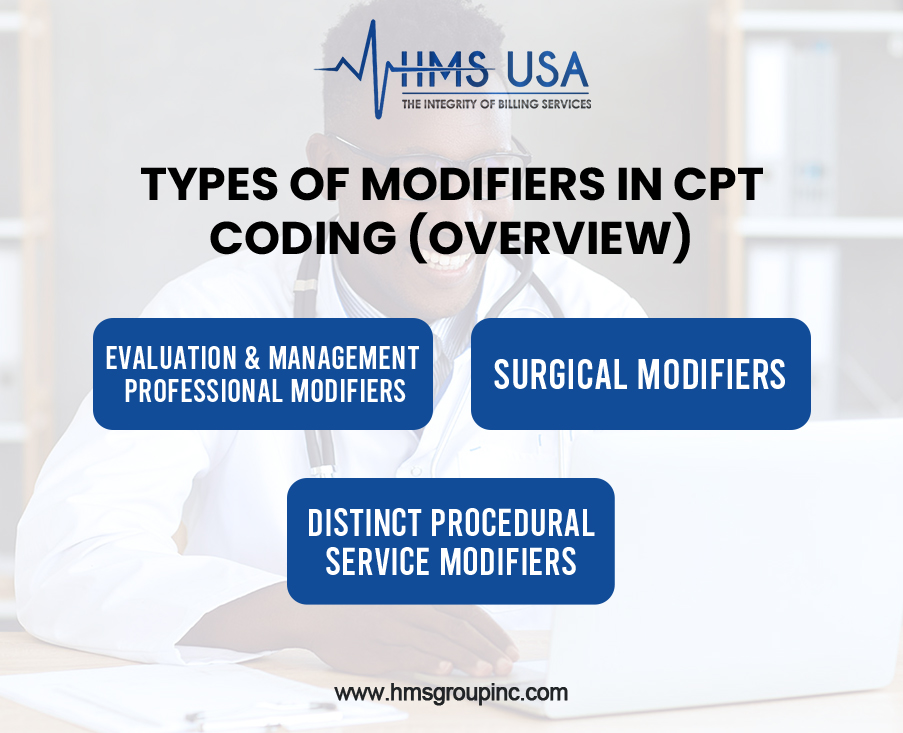
Types of modifiers in CPT coding (overview)
Understanding modifier families helps coders pick the correct one:
- Evaluation & Management / Professional Modifiers — used when an E/M visit qualifies as separate (for example, modifier 24 for unrelated E/M during a global period).
- Surgical Modifiers — for multiple procedures, repeat surgeries, reduced services, or services performed by an assistant.
- Distinct Procedural Service Modifiers (e.g., modifier 59 and the CMS “X” variants) are used to report services that are ordinarily bundled but are distinct in reality. CMS and NCCI provide detailed guidance on these modifiers to avoid misuse
High-impact modifiers — what to know (examples)
24 modifier in medical coding (Unrelated E/M during global period)
Modifier 24 is used when a provider bills for an evaluation and management service that is unrelated to a recent surgery during the postoperative global period. That visit must be clearly documented as a separate, unrelated issue.
Moreover, Medicare contractors and payers give specific guidance about acceptable documentation and deny visits billed with modifier 24 if the visit is related to the procedure or part of routine postoperative care.
Modifier 59 and the CMS X-variants (XE, XS, XP, XU)
Modifier 59 was historically used as a broad “distinct procedural service” flag; however, CMS and NCCI now recommend and support more specific X modifiers (XE, XS, XP, XU) in many situations, as they provide better clinical specificity.
However, Use of 59 or any NCCI-associated modifier must meet the criteria defined in the NCCI edits, and documentation must support the modifier’s use. Improper use can trigger NCCI denials or audit flags.
Why modifiers matter in claims processing (claims, denials & revenue)
- Reduce denials: Proper modifiers clarify why a payer should pay an otherwise bundled or excluded service.
- Improve audit defensibility: When modifiers are supported by documentation, providers can defend claims in appeals or audits.
- Support correct reimbursement: Correct modifiers enable the clearinghouse and payer to apply appropriate pricing and edits, thereby reducing underpayments or overpayments.
- Maintain compliance: Incorrect modifier use can be viewed as upcoding or abuse and may prompt audits or recoupments.
Link between modifiers and medical necessity
Modifiers do not replace medical necessity documentation; they complement it. A modifier must be supported by the clinical record showing why the service was distinct, repeated, or unrelated. When documentation aligns with modifier use, payers are more likely to accept claims and reimburse correctly.
NCCI edits, payer rules, and compliance (what coders must watch)
The National Correct Coding Initiative (NCCI) defines code pair edits and specifies whether modifiers can be used to bypass these pair edits. Each code pair has a Correct Coding Modifier Indicator that tells whether a modifier can be used to bypass that edit and under what conditions. Coders must check NCCI guidance and payer-specific rules before applying modifiers intended to bypass edits.
Impact on Revenue Cycle Management (RCM)
When modifiers are misused, more denials, longer AR days, extra resubmissions, and higher staffing costs. When used correctly, it results in fewer appeals, faster clean claims, and improved cash flow. Integrating modifier checks within pre-bill scrub and clinical documentation workflows reduces rework and speeds collection.
Technology and accuracy: how software helps with modifier selection
Modern practice management systems and EHRs can flag missing or risky modifiers and integrate NCCI/payer edits into the claim scrubber. AI-assisted coding tools can suggest candidate modifiers from clinical notes, but final clinical validation by a certified coder remains essential to ensure compliance and accurate clinical matching.
2025 CPT code changes — what coders must know (brief, authoritative summary)
The AMA’s CPT 2025 release introduced hundreds of updates (new codes, deletions, revisions) to reflect emerging services — including expanded genetic/proprietary lab codes and new E/M entries for digital/telehealth services. These changes can alter which CPT codes and modifiers are appropriate for specific encounters; therefore, coders must review the 2025 updates and update their internal coding rules and software to avoid misreporting.
Practical actions: update encoders, run training on new CPT sections (telehealth/audio-only codes, novel lab codes), and review whether existing modifier logic needs adjustment for 2025 code edits.
Common mistakes in modifier use (and how to avoid them)
- Overusing modifier 59 to bypass edits — use the more specific CMS X-modifiers when appropriate and document the clinical reasons.
- Incorrect claims during global periods (24/25/57 misuse) — ensure E/M services are truly unrelated or meet the appropriate criteria.
- Ignoring payer-specific rules — some payers restrict modifier use or require extra documentation; always check payer bulletins and contract rules.
- Insufficient documentation — if clinical notes don’t justify the modifier, denials and audits follow.
Suppose modifier errors are causing denials and revenue leakage. In that case, our medical billing services at HMS USA Inc. specialize in precise modifier application, NCCI edits management, and documentation audits to improve claim acceptance.
Best practices checklist before assigning a billing modifier
- Confirm clinical justification in the record (clear, dated provider notes).
- Verify modifier compatibility with the CPT/HCPCS code.
- Check NCCI edits (is the code pair subject to a PTP edit? CCMI flags?).
- Review payer-specific guidance for that modifier.
- Document why the modifier is necessary (e.g., separate lesion, unrelated E/M visit, distinct encounter).
- Use more-specific modifiers (XE/XS/XP/XU) when they apply instead of defaulting to 59.
The future of AI, payer automation, and the coder’s role
AI tools will increasingly suggest modifiers and flag documentation gaps, but coders will remain essential to validate nuance, clinical context, and payer rules. Payers are also improving automated claim review logic, meaning documentation must be precise, audit-ready, and aligned with modifier claims.
Final words
Modifiers in medical coding clarify clinical nuance and protect revenue, but they must be used carefully, supported by documentation, and checked against CMS/NCCI and payer rules. Regular training, updated encoders, and a rigorous audit workflow help organizations stay compliant and ensure timely payments.
FAQs
What is a modifier in medical coding?
A modifier is a two-character device added to a CPT or HCPCS code to explain exceptional circumstances of the service.
Why are modifiers necessary for claims processing?
They provide payers with context that can justify payments, reduce denials, and support accurate adjudication.
What is the 24 modifier in medical coding used for?
Modifier 24 indicates an unrelated E/M service provided by the same clinician during a postoperative global period; documentation must demonstrate that the visit is irrelevant to the surgery.
How do 2025 CPT code changes affect modifier use?
New, revised, or deleted CPT codes may change which modifiers are appropriate; coders should update encoders and review payer edits tied to new CPT guidance.
What is a common misuse of modifiers?
Overuse of modifier 59 to bypass edits is a common and risky practice; consider X-modifiers and document the clinical distinction.