
Wound care services are essential for patients with acute and chronic wounds, yet billing for these services remains one of the most denial-prone areas in healthcare revenue cycle management. Denial reasons in wound care billing often stem from documentation gaps, coding errors, and failure to meet payer-specific requirements, especially Medicare guidelines.
For providers, frequent denials don’t just delay reimbursement. They disrupt cash flow, increase administrative workload, and raise compliance risks. Understanding why denials occur and how to prevent them is critical to maintaining financial stability and delivering uninterrupted patient care.
This guide explains the most common wound care claim denial reasons, Medicare-specific challenges, billing for wound care supplies, and proven strategies to reduce claim denials in wound care.
What is Wound Care Billing and Why Are Denials So Common
Wound care billing involves submitting insurance claims for services such as wound assessment, debridement, dressing changes, infection management, and ongoing monitoring. These services often require multiple visits and evolving treatment plans, making documentation and coding more complex than standard outpatient care.
Denials frequently occur because insurers expect:
- Clear evidence of medical necessity
- Accurate and current wound care billing codes
- Detailed progress notes showing measurable improvement
- Compliance with payer-specific frequency and coverage rules
Even small inconsistencies between clinical notes and billed services can result in rejected or denied claims.
Most Common Denial Reasons in Wound Care Billing
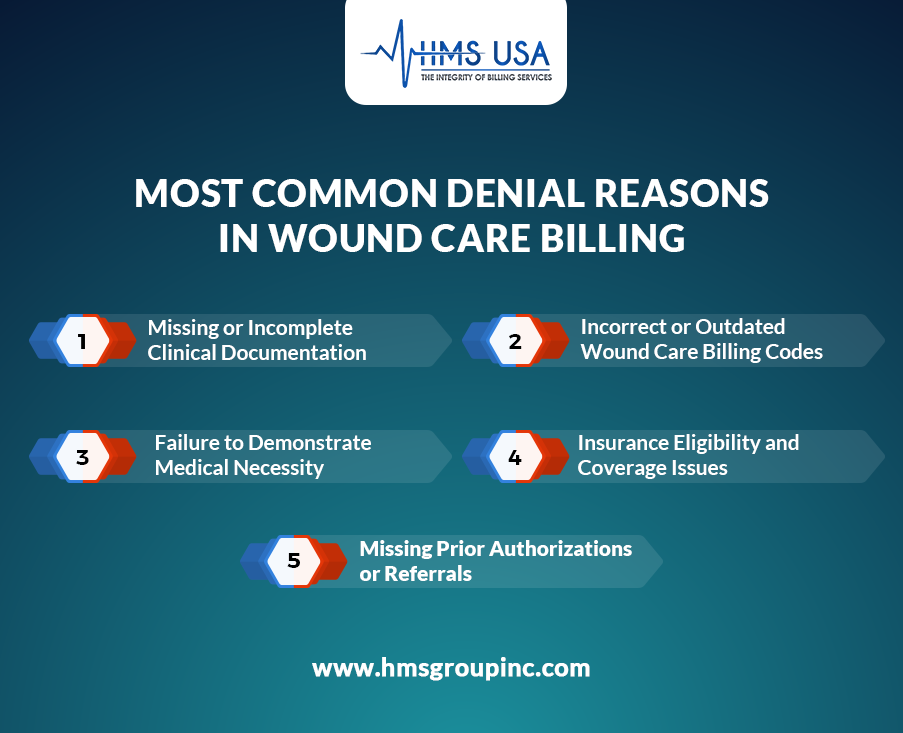
1. Missing or Incomplete Clinical Documentation
Incomplete documentation is the leading cause of wound care denials. Insurers require consistent records that clearly describe:
- Wound location, size, depth, and stage
- Type of wound (pressure ulcer, diabetic ulcer, surgical wound, etc.)
- Treatment provided during each visit
- Patient response and healing progress
Missing provider signatures, skipped progress notes, or conflicting documentation across visits often trigger denials.
2. Incorrect or Outdated Wound Care Billing Codes
Using incorrect CPT, ICD-10, or HCPCS codes or failing to update codes annually leads to automatic rejections. Common errors include:
- Mismatched diagnosis and procedure codes
- Incorrect debridement depth or surface area coding
- Missing or incorrect modifiers
Accurate coding is essential to reflect the complexity and necessity of wound care services.
3. Failure to Demonstrate Medical Necessity
Insurance carriers deny claims when documentation fails to clearly explain why skilled wound care is required. Notes must justify:
- Severity and chronicity of the wound
- Why conservative care was ineffective
- Why is ongoing professional treatment needed
Without strong medical justification, services may be labeled routine or custodial and denied.
4. Insurance Eligibility and Coverage Issues
Claims are denied when:
- Patient coverage is inactive or expired
- Services are not covered under the patient’s plan
- Coverage limits have already been reached
Verifying eligibility and benefits before treatment is a key step in preventing avoidable denials.
5. Missing Prior Authorizations or Referrals
Many advanced wound care services require prior authorization. Claims submitted without valid approvals or with expired referrals are commonly denied, even when services were clinically appropriate.
Medicare Wound Care Billing: Key Denial Triggers
Medicare Coverage Basics
Medicare wound care billing follows strict national and local coverage determinations. Covered services must be:
- Medically necessary
- Properly documented
- Billed with supported diagnosis and procedure codes
Medicare closely evaluates frequency, wound progression, and response to treatment.
Common Medicare Denial Reasons
Medicare frequently denies claims due to:
- Lack of documented wound improvement
- Exceeding frequency limits without justification
- Unsupported ICD-10 diagnosis codes
- Billing non-covered or experimental treatments
- Inconsistent clinical documentation
Even minor documentation gaps can result in delayed or denied reimbursement.
Denials Related to Billing for Wound Care Supplies
Common Supply Billing Errors
Billing for wound care supplies presents additional challenges. Denials often occur when providers:
- Bill supplies not covered by Medicare
- Use incorrect HCPCS codes
- Bill supplies separately when included in the procedure
- Fail to link supplies to a covered wound diagnosis
Quantity Limits and Modifier issues
Medicare sets strict quantity limits for dressings and supplies. Billing excessive quantities without clear justification or using incorrect modifiers frequently leads to denials.
Supplies must directly align with the wound type, severity, and treatment plan to be reimbursed.
How Wound Care Billing Guidelines Reduce Denials
Following established wound care billing guidelines helps ensure compliance and cleaner claims.
Best practices include:
- Using correct CPT, ICD-10, and HCPCS codes
- Applying modifiers accurately
- Submitting claims within payer filing deadlines
- Maintaining consistent documentation across providers
Clear, standardized processes significantly reduce audit risk and payment delays.
Proven Steps to Reduce Claim Denials in Wound Care
To reduce claim denials in wound care, providers should implement the following strategies:
- Verify insurance eligibility and coverage before treatment
- Ensure documentation clearly supports medical necessity
- Use updated wound care billing codes and modifiers
- Conduct internal claim audits before submission
- Track denial trends and address root causes
- Train clinical and billing staff on payer-specific rules
Proactive denial prevention is far more effective than reactive appeals.
To reduce recurring denial reasons in wound care billing, having the right strategy is important—but execution matters even more.
If your team is still facing frequent denials despite following best practices, it may be time to get expert support.
Let HMS USA Inc. audit your wound care billing process and identify hidden denial risks before they impact your revenue.
How Wound Care Billing Companies Improve Outcomes
Partnering with experienced wound care billing companies allows providers to focus on patient care while experts handle complex billing requirements.
Benefits of Specialized Billing Support
- Higher first-pass claim acceptance
- Reduced denial rates
- Faster reimbursement
- Improved compliance with Medicare and payer rules
- Lower administrative burden
Professional billing support helps practices maintain steady cash flow and reduce costly billing errors.
Why Choose HMS USA Inc. for Wound Care Billing Support
HMS USA Inc. specializes in helping healthcare providers overcome complex billing challenges with confidence. Our team understands the nuances of wound care billing, Medicare regulations, and payer-specific guidelines.
How HMS USA Inc. Supports Your Practice
- Expert handling of wound care billing codes
- Thorough documentation and claim reviews
- Proactive denial prevention and appeals management
- Compliance-focused billing processes
- Faster, more reliable reimbursement
Struggling with persistent denial reasons in wound care billing that are affecting your cash flow? You don’t have to manage it alone.
Partner with HMS USA Inc. today and get a customized denial reduction strategy that improves claim acceptance and accelerates reimbursements.
Conclusion
Denials in wound care billing are often the result of preventable issues such as incomplete documentation, incorrect coding, and failure to follow payer and Medicare guidelines. Left unaddressed, these denials can disrupt cash flow, increase administrative burden, and delay patient care.
By using accurate wound care billing codes, clearly documenting medical necessity, billing supplies correctly, and following established billing guidelines, providers can significantly reduce claim denials. Implementing proactive claim reviews and staying updated with payer rules further strengthens billing accuracy.
For practices seeking consistent results and fewer denials, partnering with an experienced billing team makes a measurable difference. HMS USA Inc. helps providers reduce denials, improve compliance, and secure faster, more reliable reimbursement, allowing clinicians to focus on what matters most: patient care.
For help with reducing denials and improving billing, contact HMS USA Inc. to learn how our expert services can support your practice.
FAQs
What are the most common denial reasons in wound care billing?
The most common reasons include incomplete documentation, incorrect billing codes, lack of medical necessity, missing authorizations, and errors in billing wound care supplies.
How can providers reduce claim denials in wound care?
By verifying insurance coverage, using accurate codes, following billing guidelines, and maintaining clear, consistent clinical documentation.
Why does Medicare deny wound care claims?
Medicare denies claims due to documentation gaps, exceeded frequency limits, unsupported diagnosis codes, and non-covered services.
What documentation is required to avoid wound care denials?
Providers must document wound size, location, severity, treatment plans, progress over time, and medical necessity for continued care.
How do wound care billing companies help reduce denials?
They ensure coding accuracy, documentation compliance, correct supply billing, and timely claim submission.