Accurate billing is one of the most important parts of running a successful dental practice. Every approved claim ensures steady cash flow, fewer administrative challenges, and more time to focus on patient care. Yet, claim denials remain a major issue for dental providers, often caused by simple, avoidable errors.
From incorrect CDT/CPT codes to incomplete documentation, even small oversights can disrupt reimbursement. Because dental and medical billing frequently overlap in medically necessary cases, understanding these mistakes is essential for cleaner claims and faster payments.
This comprehensive guide explains the most common mistakes that cause dental medical billing denials, and offers practical steps to prevent them.
Understanding Claim Denials in Dental Medical Billing
Claim denials occur when an insurance company refuses to pay for a billed dental service. These denials delay reimbursement, increase administrative workload, and reduce overall practice revenue. Many dental teams struggle with denials because the billing process requires precise coding, thorough documentation, and clear justification of medical necessity.
A unique challenge in dental medical billing is distinguishing between:
- CDT codes → used for traditional dental procedures
- CPT and ICD-10 codes → used for medically necessary dental services billed to medical insurance
When a service involves trauma, pathology, major infections, biopsies, or surgical complexity, medical billing rules apply. If code selection, documentation, or supporting evidence doesn’t match payer requirements, denials are almost guaranteed.
Understanding why denials happen is the first step to preventing them.
Most Common Mistakes That Lead to Claim Denials
1. Incorrect or Missing CDT Codes
One of the biggest sources of denial is inaccurate CDT coding. Even minor mistakes can stop a claim from being approved. Common errors include:
- Selecting a code that does not match the documented procedure
- Using outdated CDT code versions
- Forgetting necessary modifiers
- Failing to list multiple procedures correctly
Each year, the ADA updates CDT codes, so dental teams must stay current. Using an outdated or incorrect code can instantly trigger claim rejection, costing time, money, and productivity.
2. Improper Use of CDT Code D7210
CDT Code D7210 (surgical removal of erupted tooth requiring bone removal or sectioning) is one of the most commonly misused surgical codes.
Payers often deny this code because:
- The documentation does not confirm bone removal
- No X-rays or imaging are attached
- The extraction performed was simple, not surgical
- Clinical notes lack details about surgical difficulty
To justify D7210, the documentation must clearly show:
- Bone removal
- Sectioning of the tooth
- Use of surgical instruments
- Increased complexity vs. a routine extraction
Without these details, insurers may downcode to a simple extraction or deny the claim entirely.
3. Misuse of CPT Code 41899
When billing medical insurance, some dental procedures require CPT codes instead of CDT codes. CPT 41899, an unlisted procedure code for the oral cavity, is frequently misused.
This code should only be used when:
- No existing CPT code describes the procedure
- A procedure is medically necessary
- Detailed justification is attached
Unlisted codes require extensive documentation, including:
- Surgeon’s notes
- Rationale explaining why no other code fits
- Diagnostic imaging
- ICD-10 diagnosis codes
Without strong documentation, CPT 41899 claims face fast denial or long delays.
4. Incomplete or Weak Clinical Documentation
Lack of proper documentation remains one of the top reasons for claim denials in dental medical billing. Payers require clear, detailed evidence proving the service was necessary and performed correctly.
Common documentation problems include:
- Missing X-rays or diagnostic images
- Incomplete clinical notes
- Vague explanations of medical necessity
- Missing periodontal charts or measurements
- Insufficient surgical details
- No supporting photos for trauma cases
If documentation does not align with the submitted code, the payer cannot validate the claim, leading to denial or requests for additional information.
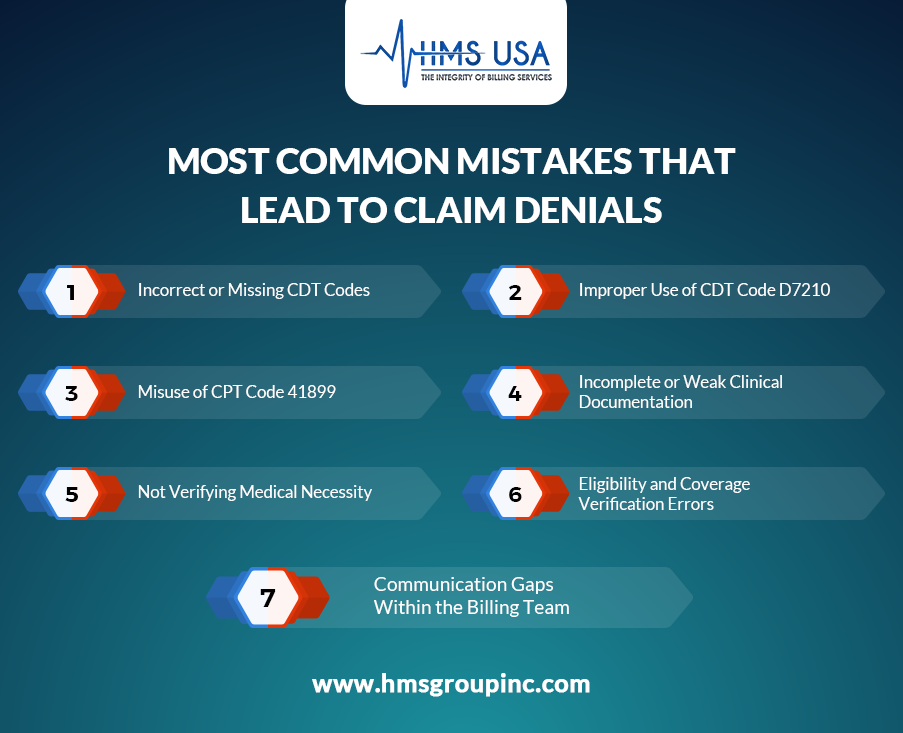
5. Not Verifying Medical Necessity
Medical necessity is crucial when submitting dental claims to medical insurance. Claims are denied when documentation does not support a clear medical reason.
Examples of poor medical necessity documentation:
- No mention of trauma, pathology, cysts, or infection
- Missing physician referrals
- No notes connecting the dental issue to systemic health
- Lack of pre- and post-op notes
Even if the procedure itself was appropriate, insurers will not approve payment without clinical justification.
6. Eligibility and Coverage Verification Errors
Many denials occur because coverage details were not checked correctly before treatment. Common issues include:
- Patient’s insurance plan was inactive
- Procedure not covered under the patient’s benefits
- Wrong plan billed (dental vs. medical)
- Missing coordination of benefits (COB)
- Not verifying frequency limitations
Example:
A medically necessary oral surgery billed to dental insurance, instead of medical, may be automatically denied.
Proper verification helps practices avoid unnecessary claim rejections and delays.
7. Communication Gaps Within the Billing Team
Internal communication plays a major role in billing accuracy. When team members assume tasks are completed, such as coding, insurance verification, or claim submission, mistakes slip through.
Communication errors often lead to:
- Missing attachments
- Wrong patient information
- Incorrect coding
- Duplicate submissions
- Missed deadlines
Standardized workflows, role assignment, and staff training significantly reduce these issues.
Best Practices to Prevent Claim Denials
1. Use Correct CDT, CPT, and ICD-10 Codes
- Use CDT codes for routine dental claims
- Use CPT + ICD-10 for medically necessary treatment
- Update codes annually
- Avoid unlisted CPT codes unless necessary
- Ensure documentation matches the selected code
Correct coding reduces the majority of denials.
2. Strengthen Documentation and Prior Authorization
- Always attach diagnostic images
- Provide detailed procedure notes
- Document medical necessity clearly
- Obtain prior authorization for surgeries, implants, and complex cases
- Verify insurance 24–48 hours before appointments
The stronger the documentation, the faster the approval.
3. Improve Team Training and Communication
- Conduct regular billing training sessions
- Assign clear responsibilities for coding, verification, and claim submission
- Use checklists for documentation
- Implement internal audits to catch errors early
A trained, organized billing team prevents recurrent denials.
4. Stay Updated with Payer Guidelines
Insurance policies frequently change. Regularly reviewing payer updates helps practices avoid rejections due to:
- New coding rules
- Updated medical necessity policies
- Changes in coverage limitations
- Modified prior authorization requirements
Staying compliant protects revenue and ensures a smoother billing workflow.
Professional Billing Support: The HMS USA Inc. Advantage
Dental medical billing is complex, time-consuming, and constantly changing. Partnering with experts significantly reduces denials and improves reimbursement accuracy.
HMS USA Inc. helps dental practices by:
- Ensuring clean claim submission
- Improving documentation and coding accuracy
- Handling CDT/CPT selection
- Managing medical billing for dental surgeries
- Reducing denial rates
- Following up on unpaid or rejected claims
- Supporting practices with complete revenue cycle management
Not sure whether your team is losing revenue to preventable billing errors? HMS Group Inc. helps dental practices identify the real causes behind claim denials in dental medical billing, strengthen documentation, and improve claim accuracy before those mistakes turn into lost payments.
Conclusion
Claim denials in dental medical billing often happen because of simple, preventable mistakes like inaccurate coding, missing documentation, and poor coverage verification.
When dental practices improve documentation, apply the correct code sets, and follow a more structured billing workflow, they can reduce denials and improve reimbursement consistency.
Want a clearer picture of where your denials are coming from? HMS Group Inc. can help your practice uncover billing gaps, reduce preventable rejections, and create a stronger path to cleaner claims and more reliable revenue.
FAQs
What are the most common reasons for claim denials in dental medical billing?
Incorrect CDT/CPT codes, missing documentation, weak medical necessity, eligibility errors, and coding mistakes by the dental billing team are the top causes.
Why is CDT code D7210 frequently denied?
It is often denied because documentation does not support a surgical extraction, or required X-rays and clinical notes are missing.
When should CPT Code 41899 be used?
Only when no specific CPT code exists for a medically necessary dental procedure, and with strong, detailed documentation.
How can dental practices reduce their denial rates?
By verifying insurance, using accurate CDT/CPT codes, improving documentation, staying updated with payer policies, and training billing staff.
What is the difference between dental and medical billing codes?
Dental claims use CDT codes, while medical claims use CPT and ICD-10 codes. Using the wrong code set often leads to denials.