Your clinic has a new physical therapist, and her schedule is filling fast. A few weeks later, billing discovers she was never added to a payer’s group contract. The visits happened, payroll went out on time, and payment is not guaranteed.
Physical therapy credentialing services take on the paperwork, documentation, and payer follow-up behind this problem. To choose one well, you need to know what they handle and what your clinic must still check.
This guide walks through the process and helps you decide whether to handle credentialing in-house or bring in outside support.
Information last verified: October 24, 2026.
Why PT Practices Confuse Credentialing with Payer Enrollment
Credentialing is a payer’s review of a clinician’s professional qualifications. It can include education, state licensing, work history, professional liability insurance, and required disclosures.
Payer enrollment sets up the provider’s record in an insurance program. Contracting defines the network participation terms, including payment rules.
People often call all three “credentialing.” That shorthand hides unfinished work. A therapist can be credentialed before the contract, group affiliation, or location is finalized.
An NPI is a separate requirement. NPPES issues it, and it does not indicate credentialing approval or payer participation.
The practical question is specific: can this therapist’s service be billed at this practice, for this date of service, under this payment arrangement, at this location?
How Credentialing Delays Cost PT Revenue
Physical therapy often involves repeated follow-up visits. Several visits can take place before the first claim is rejected and the enrollment problem comes to light.
Meanwhile, the clinic still pays salaries, rent, and operating costs. Rejected claims mean staff time spent investigating, following up with payers, and explaining coverage questions to patients.
Later approval does not automatically cover earlier visits. Effective dates, timely filing limits, retroactive billing rules, and other payment conditions still apply.
Connect enrollment tracking to your physical therapy billing services so scheduling and billing staff work from the same accurate data.
Onboarding records should include both the therapist’s employment start date and their payer participation date.
How Physical Therapy Credentialing Services Work, Step by Step
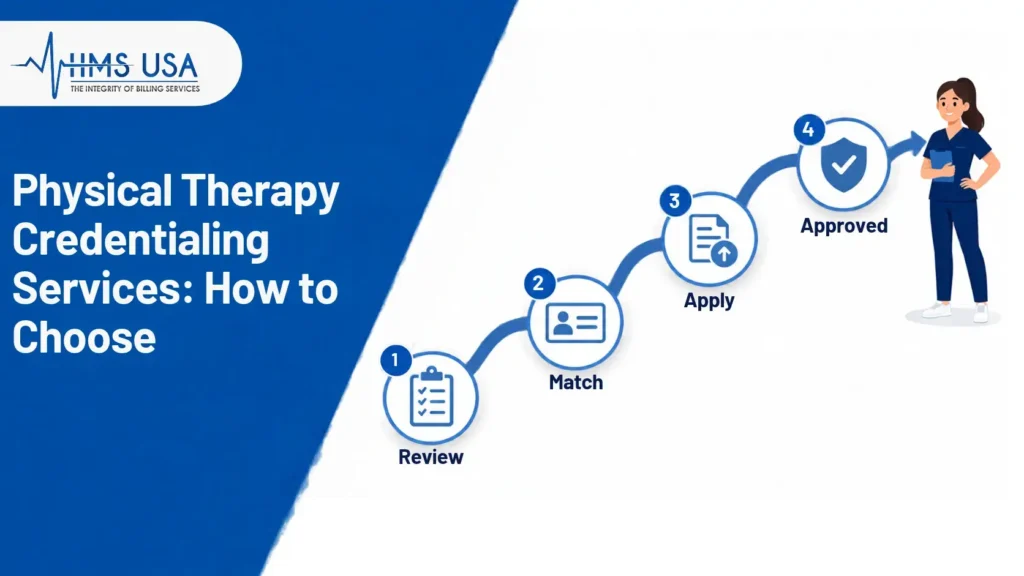
Review the Practice and Target Payers
A good service starts with your business structure, locations, provider roster, current enrollments, and the networks you want to join.
This review shows whether you need initial enrollment, a group addition, a new location, reactivation, or record corrections.
Confirm the specific network products. One insurer can run several networks, and your patients may be on a plan different from the one you applied for.
Match Provider and Business Records
The service then validates names, tax information, NPIs, taxonomies, addresses, licenses, and ownership.
A taxonomy code classifies a provider’s specialty. It should describe the provider accurately and match across records.
Small differences cause avoidable questions. For example, the legal business name on an application may not match the name on the tax documents.
Set Up Profiles and Applications
If a payer uses CAQH ProView (now called the CAQH Provider Data Portal), support can include building the profile, uploading documents, authorizing payer access, and completing the attestation steps.
CAQH shares profile information with the organizations the provider authorizes. It does not replace each payer’s application or participation decision.
Medicare enrollment is a separate process, handled through PECOS or the applicable paper forms.
Submit Applications and Resolve Requests
A good service tracks submission dates, confirmation numbers, missing items, and next steps.
A status update should say more than “pending.” Your clinic needs to know whether the application is waiting on payer review, a signature, supporting documents, or a response from another organization.
Your practice still has to answer information requests quickly and accurately.
Confirm Approval and Billing Readiness
The final handoff should include an approved list of therapists, groups, locations, network products, and effective dates.
Keep copies of approvals and payer correspondence where staff can find them. Ask about related billing setup, such as electronic claim submission and payment enrollment.
Submitting an application is a milestone. It does not prove the clinic can bill successfully.
Documents and Information to Have Ready
The exact checklist varies by payer and application. Prepare the items below in advance, then confirm each payer’s requirements.
Category | Information to prepare |
Therapist identity | Legal name, contact details, individual NPI, and requested identifying information |
Professional qualifications | State license, education, work history, and required disclosures |
Liability coverage | Malpractice insurance details and supporting documents, if requested |
Business information | Legal business name, tax ID, W-9, entity details, and organizational NPI where applicable |
Locations | Service addresses, contact details, and place-of-service information |
Ownership and management | Ownership, control, managing employee, and authorized official information, where applicable |
Payment information | Banking details and electronic funds transfer documents, as the payer requests |
Existing participation | Approval letters, payer identifiers, contracts, and group affiliations |
Keep one dated master record so staff don’t keep pulling outdated documents.
Share documents securely and through authorized accounts. The practice should keep control of its records and know who can view or change them.
Credentialing a New Clinic vs. Adding a Therapist to an Existing Group
Starting a New PT Clinic
Clinic setup involves decisions at two levels: the business and each treating therapist.
For Medicare, group practices generally use the CMS-855B for the organization, and individual therapists use the CMS-855I. A sole proprietor enrolls differently from a separately enrolled group, so not every practice needs both forms.
The right path depends on your business structure. Institutional rehabilitation providers follow different enrollment paths than private PT practices.
Build an opening plan and track each target payer separately. One approval doesn’t mean the clinic is ready for every patient on the schedule.
Adding a Therapist to an Existing Group
Confirm the new therapist’s enrollment status and their link to the group.
Participation under a previous employer does not carry over to your tax ID or location. Confirm with each payer; existing records can help.
Reassignment of benefits (ROB) lets an eligible organization receive Medicare payment for services a practitioner provides. CMS has merged the CMS-855R into the CMS-855I, so reassignment actions are now reported on the CMS-855I.
Add each new therapist to your payer tracker and keep them there until affiliations and effective dates are confirmed.
Medicare, Medicaid, and Commercial Payer Differences
Medicare Enrollment for Physical Therapists
A qualified physical therapist in private practice, including one who owns the clinic, can enroll to bill Medicare Part B for covered services, as long as they meet the applicable enrollment and practice requirements.
APTA’s Medicare enrollment FAQ for physical therapists explains how PECOS and the paper application options work. Follow the instructions for your provider type and business arrangement.
A state license does not grant Medicare billing privileges. Likewise, enrollment does not waive coverage rules, documentation requirements, or the need for accurate claims.
Original Medicare enrollment and Medicare Advantage network participation are separate processes. Check each plan you want to join.
Physical Therapist Assistants Follow Different Rules
PTAs cannot enroll in Medicare as therapy providers. Their services are billed under the supervising PT, following the applicable supervision, coverage, and reporting rules.
As of January 1, 2025, Medicare allows general supervision of PTAs by PTs in private practice for applicable outpatient therapy services. This change does not give PTAs their own billing privileges.
State requirements also apply. Check with your licensing board for any stricter supervision rules, and check Medicaid and commercial payers separately.
Medicaid Enrollment Is State-Specific
Medicaid provider enrollment varies by state, and managed care participation adds a separate layer through each health plan.
State enrollment and managed care network contracting are not the same thing. Check requirements with the state agency and with each plan before assuming a provider is ready to bill.
When you expand into a new state, review our [physical therapy billing guide for that state](INTERNAL LINK: relevant physical therapy billing page for state) along with the state’s official enrollment instructions to see what local issues your staff need to handle.
Commercial Payers Confirm Participation by Network
Participation can depend on the insurer, network product, group agreement, provider, and location.
In-network means the therapist participates in the specific network that applies to the patient’s plan. Out-of-network reimbursement is not a dependable substitute for unfinished enrollment, because it depends on the patient’s benefits and the payer’s rules.
Don’t plan your schedule around a vague payer reply that a therapist is “already credentialed.” Ask for the effective date in writing.
How Long Does PT Credentialing Take?
No single verified turnaround applies to Medicare, every state Medicaid program, and every commercial network.
CMS notes that PECOS applications generally process faster than paper applications. That is not a promised approval date for any specific practice.
Ask for an estimate by payer and application type, and ask when the clock starts: when the vendor receives your paperwork, when the application is submitted, or when the payer accepts a complete file.
Common causes of delay include missing signatures, incomplete group or location documents, inconsistent data, additional document requests, and unresolved disclosures.
Track preparation, submission, payer review, approval, and effective date as separate stages. That shows what the service controls and what is up to the payer.
Plan well ahead of every clinic opening and each therapist’s first patient visit, and remember that every payer keeps its own timeline.
Recredentialing, Revalidation, and Keeping CAQH Current
These duties continue after the first approval.
Recredentialing is a payer’s periodic review of professional qualifications. Follow each payer’s interval and notices; don’t assume all plans use the same one.
Medicare revalidation renews your enrollment record. Most providers and suppliers, including PT practices, revalidate every five years, and CMS can request revalidation sooner. Follow your scheduled due dates.
CAQH requires providers to re-attest every 120 days (180 days in Illinois), and a missed deadline changes the profile status to expired. See the CAQH re-attestation requirements and any payer-specific update rules.
Keep a calendar for these tasks, plus license renewals, insurance expirations, and practice changes. An update in one system does not automatically update every payer’s records.
Common Mistakes That Cause Rejections and Delays
Mistake | Practical fix |
Conflicting names, tax IDs, or addresses | Reconcile source records before submitting |
Group approved, but therapist not linked to it | Verify each therapist’s status and group affiliation |
CAQH documents uploaded, but attestation or payer authorization left incomplete | Review attestation, authorization, and open profile items |
Wrong application route selected | Check the legal structure and enrollment goal |
Assuming approval covers earlier visits | Confirm the effective date and retroactive billing rules |
Payer requests go unanswered | Assign a main and a backup contact |
Payer approval confused with permission to practice | Check state practice authority separately |
State physical therapy boards set licensure and scope-of-practice rules. Check with the board in every state where your clinicians practice for current requirements.
In-House vs. Outsourced Credentialing
In-house management can work if a clinic has experienced staff, a manageable application volume, and time set aside for follow-up.
Outsourcing can help practices that are opening locations, dealing with turnover, or struggling with slow follow-up. It still needs someone inside the clinic who can supply information and make decisions.
Consideration | In-house | Outsourced |
Staffing | Needs training, commitment, and backup coverage | Needs vendor oversight and an internal contact |
Visibility | Relies on in-house tracking | Depends on the vendor’s reporting and your access |
Workload | Competes with other administrative tasks | Vendor capacity needs to be confirmed |
Cost | Staff time, training, and tools | Service fee plus any extra charges |
Record control | Managed by the practice | Protect with access terms and handover conditions |
A hybrid model can also work: the practice keeps source records, and an outside specialist handles applications and follow-up.
Outsourcing doesn’t guarantee approval. Decide based on workload, skills, and accountability.
Pricing Models and What Affects Cost
Compare proposals by scope, not just the headline price.
A service may charge per provider-payer application, offer a clinic launch package, or charge an ongoing maintenance fee. Credentialing can also be bundled into a larger billing contract.
Ask how extra sites, group applications, reassignments, reactivations, and corrections affect cost. Check whether ongoing maintenance and contract support are included.
The agreement should say what happens if a payer declines to participate or closes its panel. A service can complete application work without obtaining approval, so ask whether fees apply either way.
Service fees are not standardized nationally. Give every vendor the same list of therapists, payers, locations, and deliverables so you can compare them like for like.
How to Choose Physical Therapy Credentialing Services
A useful proposal spells out responsibility, communication, and completion.
Question to ask | Evidence to request |
Do you understand PT private-practice enrollment? | A clear explanation of individual, group, and assistant differences |
Which payers and products are covered? | A named list in the written scope |
Who supplies missing information? | Assigned responsibilities and escalation steps |
How is progress measured? | Submission dates, reference numbers, blockers, and next actions |
How will completion be confirmed? | Approval documents, effective dates, and a billing handoff |
Who owns the records? | Practice keeps access, with a handover on exit |
How are documents protected? | Defined access limits and secure data transfer |
What costs extra? | Written fee terms and exclusions |
Ask for a redacted sample status report. It shows how the service communicates and what happens when an application stalls.
Be wary of promises of acceptance or guaranteed results. Payers make the participation decisions.
How HMS USA Supports PT Credentialing
HMS USA offers credentialing, medical billing, revenue cycle management, and denial management services.
PT practices can discuss enrollment needs together with billing workflows, since billing depends on accurate provider information. Before starting, ask for a written scope that lists therapists, locations, target payers, current issues, and ongoing maintenance.
Review HMS USA’s [provider credentialing support](INTERNAL LINK: HMS USA credentialing services page) to see the work involved, the reporting you’ll receive, and what your clinic still handles.
Confirm the exact PT enrollment scope. A general service agreement may not cover every application, payer, or maintenance task.
Choose Support That Makes Billing Readiness Clear
Physical therapy credentialing services should tell your clinic what was submitted, what is still outstanding, and when payer participation starts.
Begin with a list of therapists, locations, and target payers. Then decide whether your team can handle the workload or needs outside support.
HMS USA can review your needs and the scope of support you want, so you can decide on next steps.
Payer requirements and portals change. Confirm current enrollment, billing, and practice requirements with each payer and your state board. This article offers operational information, not legal advice.
Frequently Asked Questions
How do physical therapists get credentialed with insurance?
They go through each payer’s participation process: submitting professional and practice information, completing the required credentialing and enrollment steps, and confirming contract terms and effective dates. CAQH can help collect information, but it does not replace a payer’s process.
How long does physical therapist credentialing take?
It depends on the payer, the application type, how complete the paperwork is, and any open review steps. Ask for an estimate for your specific application and find out when the clock starts. No single national turnaround applies.
Can a physical therapist bill while enrollment is pending?
Not reliably. Pending enrollment does not guarantee payment or in-network billing. Ask the payer about effective dates and retroactive billing rules, and don’t assume later approval covers earlier services.
Do physical therapists enroll individually or as a group?
It depends on the business structure and the payer. In Medicare, a PT group enrolls as an organization, each therapist enrolls individually, and reassignments connect them. Sole proprietors follow a different path.
Do PTAs enroll in Medicare on their own?
No. PTAs cannot enroll separately as Medicare therapy providers. Their services must follow the applicable billing arrangement and any supervision and reporting requirements.
If a therapist has a CAQH profile, are they credentialed?
No. A CAQH profile stores information that authorized organizations can access. Each payer still makes its own credentialing and participation decision.
Can a PT practice handle credentialing without a service?
Yes. With the right experience, staff, and time, applications and maintenance can be handled in-house. Outsourcing is a decision about workload, skills, cost, and accountability.