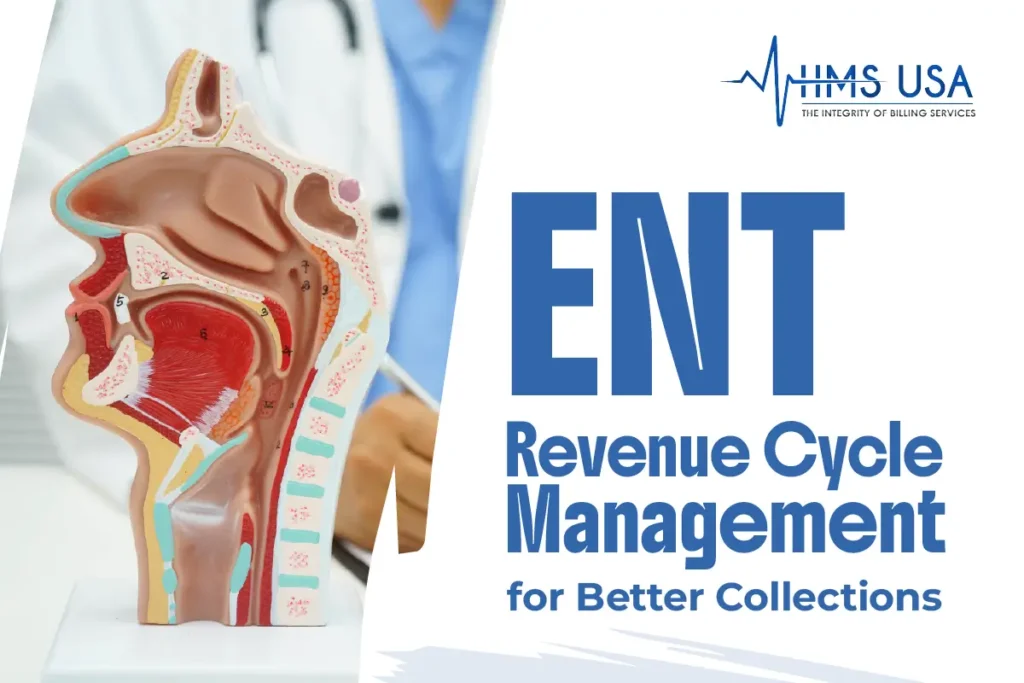
Even when money is not being collected, the ENT practice can be very active. It can happen due to lack of authorization, lack of an endoscopy report, or even a wrong adjustment. Ent revenue cycle management provides integration of administrative and financial activities related to each visit so that you could find out why the claim is not paid, what kind of information is lacking, and whose responsibility it is to fix it.
You need to make sure that your process covers different kinds of ENT procedures, including visits to the office, surgeries, audiology, and allergy treatment. This article highlights important controls for ENT revenue cycle in terms of each service line, the metrics that need your attention, and the questions that will help you understand which direction to take.
1. ENT Services Obey Different Payment Rules
The otolaryngology revenue cycle management involves multiple payment cycles for one practice. A consultation, nasal endoscopy, hearing test, and surgery will have different insurance plans, documentation, and payment procedures. In the case of a surgery done in the ASC, the claim for the surgeon is separate from the claim for the facility. One being paid does not mean that the other is done properly.
Separate audits need to be conducted for audiology billing and allergy treatment. While it is necessary to differentiate between hearing assessments and hearing aid benefits, one must record allergy assessment, extract preparation, and injection as separate procedures. Distinguishing these categories within your billing system will enable you to detect any unpaid balances that are hidden behind successful office visits.
2. Seven Handoffs Influence ENT Revenue Cycle Management
A reliable process assigns each financial activity its owner and a document outcome. The following seven handoffs are related to scheduling, clinical documentation, billing and reconciliation of results.
Verify Patient Registration Information
Match patient identity, subscription details, plan, coordination of benefits. Address discrepancies prior to claim submission. An exact copy of an insurance card cannot prove the accuracy of registration information.
Confirm Provider Participation Relationships
Verify the relationships between the rendering provider and the billing organization and the site of service. Even credentialing does not always mean that all participations relationships for payments will be fulfilled. Unresolved participation issues should remain visible for scheduling personnel.
Confirm Coverage Before Service
Identify covered services, benefits of specialists, referrals, patient liabilities, exclusions. Document the payer reply and source. The active status of a policy does not ensure coverage of all procedures.
Matching Authorization to Services
Match the information from the authorization with the proposed procedure, provider, facility, units, and the allowable service period. An alteration in the surgery place or type necessitates a new authorization review and not an assumption.
Matching Documentation to Charges
Match encounters performed, procedure notes, audiology notes, and allergies with posted charges. Find missing items. When documentation is lacking essential details, ask for more information but not a diagnosis or procedure that cannot be confirmed.
Submit Claims, Get Confirmation Of Acceptance
Make sure claims are correct and check the clearinghouse and payer acknowledgment messages. Just because a claim is “sent” does not mean it cannot be revised. The proof of acceptance should be easily accessible to help make your case if there is a problem.
Reconcile Payments And Balances
Record payments, allowed adjustments, secondary insurance, and assign a follow-up task for each balance. It is important that the work notes describe the issue and the follow-up required, not just that the follow-up needs to be done.
3. Code Reviews to Ensure Non-Preventable Errors Are Not Made
ENT coding must be in accordance with the procedure that is documented, AMA CPT guidelines, CMS edits and payer policies. According to AAO-HNS, 31231 is for diagnostic unilateral or bilateral nasal endoscopy; therefore, examination of both sides alone is not enough reason for bilateral billing.
- Ensure documentation of 31231 includes diagnostic endoscopy along with the medical necessity for the procedure.
- Report 92557 if all components of audiometry have been done.
- Confirm 69436 involves placing ventilating tube under general anesthesia.
- Add modifier 25 when there is separate E/M documentation.
- Review NCCI edit indicators prior to applying any separate service modifier.
- Differentiate between allergen extract preparation and administration.
- Use correct diagnosis specificity and laterality as per clinical documentation.
4. Turn Denial Patterns Into Corrective Actions
ENT claim denials need different responses depending on the payer’s stated reason. A corrected claim changes inaccurate information; an appeal challenges a determination using supporting evidence. Repeated submission without that distinction can create duplicate claims.
| Problem | Evidence to review | Appropriate response |
|---|---|---|
| Authorization mismatch | Approved scope compared with the actual service | Investigate amendment or review options permitted by the plan. |
| Bundled services | Code-pair edit, modifier indicator, and procedure record | Correct inaccurate coding or appeal supported separate reporting. |
| Medical necessity denial | Coverage criteria and relevant clinical records | Address the specific unmet criterion with documented evidence. |
| Filing dispute | Submission history and payer acceptance | Supply applicable proof through the required dispute route. |
| Apparent underpayment | Contracted allowance and remittance adjustments | Calculate the supported variance before requesting reconsideration. |
For example, a case moves to another surgery center while its approval still identifies the original facility. Resolving that balance requires reviewing the plan’s available options. Preventing recurrence requires connecting location changes to the authorization worklist.
Find Out the Source of Claims That Were Not Paid
Ask HMS USA to audit some of the outstanding claims using the relevant documentation.
This will aid in uncovering the repeating mistakes and implementing solutions.
5. Measuring Collections With Consistent Definitions
The ENT Practice collections dashboard should separate the metrics of financial performance from the process of claims submission. Although the AAFP guidelines provide useful benchmarks for general practices, they are not ENT practice-specific guarantees.
- Days in A/R: Receivables ÷ Average Daily Charges using consistent treatment of credit. According to AAFP, 30-40 days are preferred.
- Adjusted Collection Rate: (Net Payments / Charges – Adjusted Contractual Allowance) × 100. AAFP offers a general benchmark range of 95%-99%.
- Denial Dollar Rate: Denied Claim Dollars ÷ Submitted Claim Dollars × 100. AAFP indicates that below 5% is preferred. Use similar claim populations.
Keep track of claim acceptance separately. The clearinghouse acceptance, the payer acceptance, and payment are three different things. So, the denial rate of claims cannot be compared with denial rate measured in dollars.
An example of $200 allowable amount can clarify this point. The $120 from insurance company payment plus legitimate $80 from the patient responsibility does not mean underpayment. The application of $160 allowable amount against legitimate $200 contractual allowance creates a difference of $40 to investigate.
6. Offer Patients a Balance They Can Understand
The patient bill must differentiate among estimates, deposits, balance pending insurance approval, and balance of responsibility. If the procedure involves a surgical operation, determine if the estimate is for the surgeon alone or for the facility, anesthesia, and any other professionals.
Example: A patient challenges the statement based on having paid a deposit. An appropriate reply would be a statement explanation detailing the deposit, insurance process, adjustment approval, and balance of responsibility.
Offer understandable statements, acceptable payment alternatives, and a dispute resolution process. Balance deposits with the adjudicated balance and send the refunds for approval. An insurer rejection is insufficient to prove that the patient owes the balance.
7. Compare Internal Billing With Outsourced Support
ENT billing services should address a defined capacity or expertise gap. Compare the actual work covered, management effort, and total cost rather than choosing solely on a quoted collection percentage.
| Decision | Internal team | Outside partner |
|---|---|---|
| Staffing | Practice manages hiring, training, and backup | Verify the vendor’s assigned staff and coverage |
| Expertise | Depends on available specialty knowledge | Request de-identified ENT work examples |
| Visibility | Requires disciplined internal reporting | Requires claim access and clear reporting rights |
| Cost | Include software, benefits, training, and supervision | Include exclusions, setup, and retained internal tasks |
A hybrid arrangement can preserve patient communication internally while outsourcing selected billing functions. Define ownership of unresolved A/R, credit balances, records, and system access if the arrangement ends.
8. Use Automation With Reviewable Controls
The RCM automation tool could handle eligibility checks, missed charges, payments matching, and worklist generation. This is contingent upon precise rules and proper exception handling.
Automate repetitive tasks. The useful authorization comparison is focused on pertinent fields, not on the mere presence of a number.
Review the important decisions. Professional personnel should check the suggested coding and draft appeals based on the artificial intelligence analysis against patient documents and actual payer policy.
Ensure access control and security of data. HHS recommendations are aimed at addressing authentication, audit controls, and securing electronic protected health information. The billing vendors acting as business associates must have appropriate agreements in place. The same applies to cloud or AI services used to analyze the patient information.
Maintain individual user access, authorized record transfer procedure, and an audit trail for the billing changes. The signed agreement should complement operational security measures, not replace them.
9. Ways in Which HMS USA Could Assist ENT Practices to Handle Billing
HMS USA is capable of performing agreed-upon revenue cycle services that include eligibility determination, claim submission, payment posting, denial handling, account receivable handling, and Medical Credentialing Services. The extent of scope will depend on the nature of your practice systems, mix of payers, services, and internal staffing capabilities.
A realistic scope of services agreement will define:
- What services will be performed by HMS USA and what not.
- Whose responsibility it is to address questions related to documentation and authorize modifications.
- To what extent your management can access report and claim note.
- How to escalate any outstanding issues to right level of decision-making.
The clinical documentation will still rest with your physicians while coverage decisions will continue to be dictated by payer policies.
Hire Focused ENT Billing Services
Speak to HMS USA about the coding, claims, and collections issues at your practice. Talking with a focused mind will help determine the services you need and the duties you want to retain.
10. Frequently Asked Questions
What does ENT revenue cycle management include?
ENT revenue cycle management covers the financial tasks surrounding otolaryngology care, from registration and benefits verification through coding, claims, payment posting, and collections. It also coordinates requirements for surgery, office procedures, audiology, and allergy services, with clear responsibility for resolving unpaid or incorrectly processed balances.
Can an office visit and nasal endoscopy be billed together?
An office visit and nasal endoscopy may be separately reportable when documentation supports a significant, separately identifiable E/M service beyond the procedure’s usual work. Modifier 25 applies to the E/M code when justified. The decision to perform endoscopy alone does not establish separate E/M reimbursement.
Does prior authorization guarantee payment?
No. Authorization confirms an approval within specified conditions, but payment also depends on eligibility, benefits, provider participation, medical necessity, coding, and claim accuracy. Your team should compare the rendered service with the approved procedure, provider, setting, units, and other requirements before relying on that approval.
Which financial metrics should an ENT practice track?
Track days in A/R, adjusted collection rate, dollar denial rate, and claim acceptance using consistent definitions. AAFP’s general practice guidance identifies 30–40 A/R days, 95%–99% adjusted collections, and denials below 5% as useful reference points. Interpret them against your own practice’s payer and service mix.
Is outsourcing always better than internal billing?
Outsourcing can help when specialty coding needs, unresolved claims, staffing gaps, or reporting limitations exceed internal capacity. It is not automatically the better option. Compare documented capabilities, total fees, system access, and retained responsibilities with your internal operation before choosing full outsourcing or targeted support.
Can 92557 be billed with its component tests?
ASHA explains that 92557 combines pure-tone and speech audiometry components. Reporting included components separately can create duplicate billing. If the full test battery was not completed, review the services actually performed and the applicable reporting instructions rather than billing 92557 solely because it was ordered.