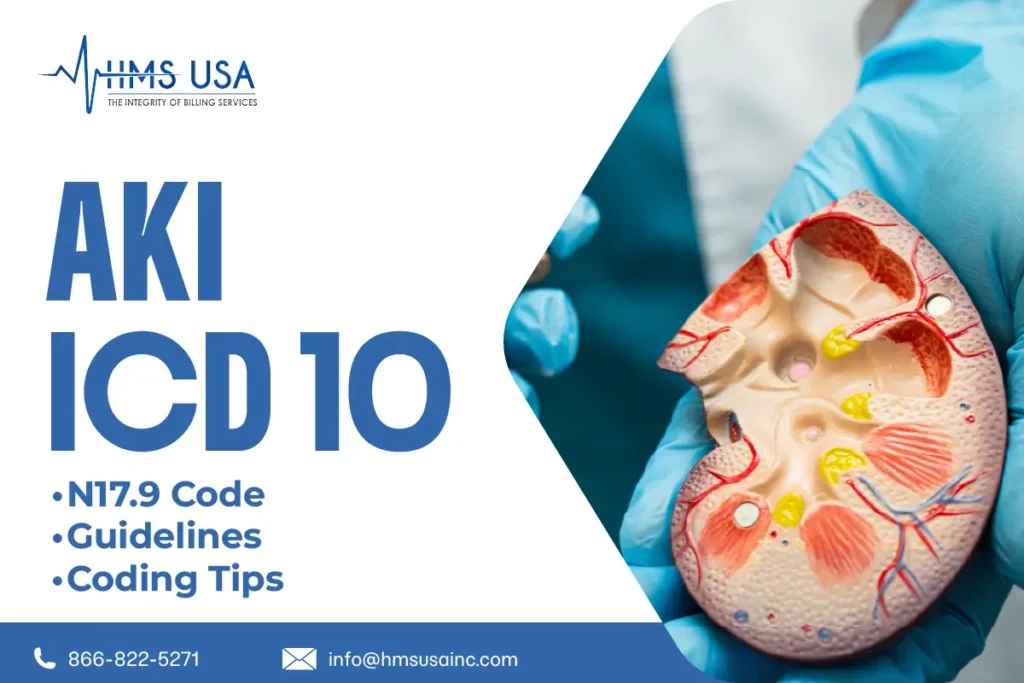
The ICD-10-CM code for acute kidney injury (AKI) is N17.9, Acute kidney failure, unspecified, when the provider documents nontraumatic AKI without a more specific classified type. Other codes in the N17 family apply when the diagnosis specifies tubular necrosis, acute cortical necrosis, medullary necrosis, or another form classified to N17.8.
Finding the code is straightforward. Matching it to the chart takes more care. A documented cause, a clinical severity stage, or an abnormal creatinine result does not, by itself, establish a specific N17 subtype. The distinctions below explain where coding specificity comes from and which documentation gaps need clarification.
AKI ICD 10 Quick Reference: The N17 Code Family
| Code | Official description | Documentation supporting code selection |
|---|---|---|
| N17.0 | Acute kidney failure with tubular necrosis | A provider diagnosis of acute tubular necrosis or an equivalent indexed term. |
| N17.1 | Acute kidney failure with acute cortical necrosis | A documented diagnosis of acute cortical necrosis or an equivalent indexed term. |
| N17.2 | Acute kidney failure with medullary necrosis | Documented medullary or papillary necrosis classified here. |
| N17.8 | Other acute kidney failure | Another specified form directed here by the Alphabetic Index and verified in the Tabular List. |
| N17.9 | Acute kidney failure, unspecified | Documented AKI without a more specific classified type. |
N17 is a category heading. Select the complete code that applies to the claim. The five codes above are complete diagnosis codes, but each still requires appropriate documentation and must meet applicable reporting rules.
Category N17 also includes a “code also” instruction for an associated underlying condition. That instruction does not, by itself, require the cause to be sequenced first.
AKI Terminology and the Coding Record
Acute kidney injury is a sudden decline in kidney function. Clinicians assess changes in serum creatinine, urine output, the patient’s baseline kidney function, and the overall clinical situation. KDIGO provides clinical guidance for diagnosis and severity assessment.
Causes are commonly grouped as reduced kidney perfusion, injury within the kidney, or urinary tract obstruction. These groups help explain the disease, but they do not map directly to the N17 subcodes.
Reduced perfusion alone does not establish tubular necrosis. Likewise, urinary obstruction does not automatically make N17.8 the correct choice. The provider’s diagnostic wording and the classification determine the coding path.
Reduced urine output, swelling, and fatigue may occur, but they do not identify a particular renal subtype. Some patients have few obvious symptoms. A symptom list cannot replace the clinician’s diagnostic assessment.
Acute renal failure and acute kidney failure can lead to the same N17 classification as AKI. Acute renal insufficiency, however, is classified differently. Similar wording deserves a careful Index review.
WHO maintains the international ICD classification, while CDC/NCHS maintains ICD-10-CM for U.S. diagnosis reporting. Guidance written for another country’s modification may use different code structures or instructions.
Selecting the Code Supported by the Diagnosis
N17.9 Is Appropriate When the Classified Type Is Unspecified
N17.9 can be appropriate even when the chart explains the cause of AKI. For example, documented prerenal AKI caused by dehydration may support N17.9 when no necrosis or another more specific classified type is established. Report dehydration separately when it meets reporting requirements.
“Unspecified” describes the classification detail available for the code. It does not necessarily mean the clinician has no explanation for the condition.
Review the full assessment, relevant consultant documentation, and applicable Index entries. A query may help resolve ambiguity that affects accuracy. An otherwise appropriate unspecified code does not automatically require a query simply because a more specific code exists.
Necrosis Codes Require the Corresponding Diagnosis
N17.0 describes acute kidney failure with tubular necrosis. Hypotension, nephrotoxic medication exposure, and abnormal urine findings may support clinical review, but they do not allow a coder to independently diagnose acute tubular necrosis (ATN).
The same principle applies to N17.1 and N17.2. Sepsis alone does not establish cortical necrosis, and diabetes alone does not establish medullary necrosis.
When AKI and ATN describe the same acute renal condition, N17.0 captures the specified diagnosis. Adding N17.9 would duplicate that condition at an unspecified level. Conflicting assessments should be clarified through the appropriate documentation process.
N17.8 Requires a Supported “Other” Classification
N17. 8 is coded for different specific form of acute kidney failure when the Alphabetic index directs you to that code and the Tabular List supports selection. This is not to be applied as a blanket for atypical presentation, systemic illness or even risk factors.
Start with the provider’s diagnosis in writing and check what modifiers are in play (e.g., “acute,” or some defined form of necrosis). Guidelines for using the Index references, and then also read through the candidate code in Tabular List (the options above), parent category & instructions This close scrutiny also comes into play in precisely having Medical Billing Services, especially where claims are with reference to complicated renal diagnoses.
More clinical detail does always imply N17. 8. The details you hold should correlate to the level of classification being reported. Moreover, abbreviated code descriptors in billing software may omit directives that appear in the complete ICD-10-CM classification, so be sure to confirm the full entry before submitting the claim.
Clinical AKI Stages Do Not Determine N17 Digits
KDIGO stages describe clinical severity. The N17 subcodes distinguish classified types of acute kidney failure.
N17.2 does not mean stage 2 AKI. It describes acute kidney failure with medullary necrosis. Documented stage 1, 2, or 3 AKI may still be coded to N17.9 when no more specific classified type is established.
The clinical stage remains useful for assessment and management. It should not be converted into a matching decimal digit in the diagnosis code.
AKI on CKD: Report Both Conditions When Supported
When acute kidney failure and chronic kidney disease (CKD) are both documented and meet reporting requirements, assign the appropriate acute kidney failure code and the CKD code.
No single code combines both diagnoses. Unlike the N17 subcodes, CKD codes do distinguish disease stages.
| Code | Official description |
|---|---|
| N18.30 | Chronic kidney disease, stage 3 unspecified |
| N18.31 | Chronic kidney disease, stage 3a |
| N18.32 | Chronic kidney disease, stage 3b |
| N18.4 | Chronic kidney disease, stage 4 (severe) |
A documented diagnosis of unspecified AKI on CKD stage 3b can support N17.9 and N18.32. The codes represent different acute and chronic components of the patient’s condition.
N18.3 is a parent subcategory and is not a complete code for submission. Select N18.30, N18.31, or N18.32 according to the documented stage detail. Do not choose an unspecified CKD code when the record supports a specific stage.
Use the provider’s CKD assessment. An estimated glomerular filtration rate (eGFR) affected by AKI does not authorize the coder to independently assign or change the CKD stage. If staging is inconsistent, seek clarification.
Associated diabetes or hypertension may require combination codes and additional sequencing review. Consider those relationships and the N18 instructions as part of the complete claim.
Neither the AKI code nor the CKD code automatically takes the first position. Sequencing depends on the circumstances of the admission or encounter and applicable instructions.
Associated Conditions and Related Code Choices
Dehydration and Urinary Obstruction
E86.0 describes dehydration. AKI and dehydration can both be reported when each is documented and meets reporting requirements. IV fluid administration alone does not establish either diagnosis.
For obstructive AKI, review the documented obstruction and its cause through the Index and Tabular List. A urinary stone, hydronephrosis, and bladder outlet obstruction are different conditions and may lead to different code selections.
Do not create a causal relationship from neighboring problem-list entries. When the relationship between AKI and another condition is unclear and affects coding, consider a focused query.
The goal is documentation that reflects the established conditions and their supported relationships. Dehydration or obstruction alone should not be used to infer a particular renal subtype.
Sepsis and Acute Organ Dysfunction
Coding sepsis with AKI requires attention to both the diagnoses and their relationship. A41.9 describes sepsis with an unspecified organism. Use a more specific sepsis code when the documentation supports one.
When AKI is documented as acute organ dysfunction associated with sepsis, follow the severe-sepsis instructions. R65.20 describes severe sepsis without septic shock; R65.21 describes severe sepsis with septic shock. Report the underlying systemic infection and the associated organ dysfunction as required.
The presence of both sepsis and AKI does not automatically establish that relationship. Another cause of AKI may be documented. Query the provider when the relationship is unclear.
A code from subcategory R65.2 cannot be the principal diagnosis. Review infection, organ dysfunction, shock, and any special circumstances under their applicable sequencing rules.
Hepatorenal Syndrome
K76.7 describes hepatorenal syndrome. Cirrhosis and impaired kidney function alone do not establish this diagnosis.
The N17–N19 block contains an Excludes2 note for hepatorenal syndrome. An Excludes2 note permits both conditions to be reported when appropriate; it does not require automatic dual coding.
Determine whether the record describes hepatorenal syndrome alone or another separately documented renal condition. Clarify ambiguity and consult relevant AHA Coding Clinic guidance for the specific situation.
Contrast, Medications, and Procedural Complications
N14.11 describes contrast-induced nephropathy. Its Excludes2 note for acute kidney failure permits both diagnoses to be reported when supported and otherwise appropriate.
Contrast exposure alone does not establish contrast-induced nephropathy or ATN. In drug-related cases, distinguish an adverse effect from poisoning and follow the relevant drug-identification and sequencing instructions.
N99.0 describes postprocedural acute or chronic kidney failure. It includes an instruction to use an additional code to identify the type of kidney disease.
Kidney failure occurring after surgery is not automatically a procedural complication. The provider’s documentation must support the relationship between the care provided and the kidney failure. Review the applicable classification rather than assuming all renal findings associated with a procedure follow the same coding path.
Similar Terms With Different Codes
| Documented term | Coding distinction |
|---|---|
| Acute renal insufficiency | Included under N28.9, Disorder of kidney and ureter, unspecified. Clarify the diagnosis if the record is ambiguous about AKI. |
| Kidney failure without acute or chronic specification | N19, Unspecified kidney failure, may apply. Do not substitute it for documented acute kidney failure. |
| Azotemia alone | Review the documented term in the Index. Do not treat a laboratory finding as an AKI diagnosis. |
| End stage renal disease | N18.6 requires the corresponding documented diagnosis. |
| Dialysis dependence | Z99.2, Dependence on renal dialysis, describes a status rather than an AKI subtype. |
Dialysis used to treat AKI does not, by itself, establish end stage renal disease or ongoing dialysis dependence. Review the documented diagnosis, treatment, and status.
Excludes1 and Excludes2 Have Different Meanings
Category N17 has an Excludes1 note for posttraumatic renal failure, directing the coder to T79.5, Traumatic anuria. Follow the injury classification and supply the required additional characters.
An Excludes1 note generally prevents reporting the excluded condition with the code containing the note. The exception for unrelated conditions requires careful review.
N17.9 has an Excludes2 note for traumatic kidney injury in the S37.0- family. A separately documented traumatic kidney injury and nontraumatic AKI may coexist. The note permits appropriate reporting of both; it does not establish either diagnosis.
Read instructions at the code, category, block, and chapter levels. A note shown under a broader heading may apply to every code beneath it.
Documentation That Makes the Coding Decision Clear
A useful renal assessment states the diagnosis clearly and explains relevant relationships. An abnormal creatinine result or a record of fluid replacement does not provide the same information.
Helpful documentation includes:
- The renal diagnosis and any established subtype.
- Relevant baseline information, creatinine results, and urine output.
- The identified cause and its relationship to the kidney disorder.
- The documented CKD stage, when applicable.
- Evaluation, treatment, monitoring, and the condition’s clinical significance.
Nursing observations and laboratory records can support the assessment. They do not replace the diagnosis of the provider legally accountable for establishing it.
For coders, code assignment and clinical validation are related but distinct tasks. Code assignment follows the provider’s diagnostic statement. Clinical indicators can help identify a need for clarification, but the coder should not independently diagnose AKI by applying a personal threshold.
When documentation conflicts or the diagnosis appears clinically unsupported, follow the organization’s clinical-validation and query process. Keep the supporting information clear enough for another reviewer to understand the decision.
A Neutral Documentation Query
An open-ended query can begin with the precise, relevant information in the record:
The attending assessment documents acute kidney injury, while the consultant assessment documents acute renal insufficiency. Relevant findings include [documented laboratory results, observations, and treatment]. Please clarify the renal diagnosis that best describes this encounter, including the cause or subtype if clinically established. If the diagnosis cannot be determined, please document that.
Adapt the wording to the actual chart. Include relevant supporting and conflicting information, preserve the provider’s independent judgment, and avoid references to reimbursement.
Close the Documentation Gap
A second coding review can help identify unclear diagnoses, missing relationships, and unsupported specificity. Discuss a challenging renal chart with HMS USA’s coding support team.
Encounter Settings, Reporting, and Resolved AKI
Uncertain-diagnosis rules differ by care setting. Inpatient cases that qualify for the inpatient facility-level of care can utilize a diagnosis reported as probable or suspected at discharge and assign it as if it were an established diagnosis per the inpatient guidelines.
There is another set of rules for outpatient, emergency department, observation and professional claims. Even if the suspected condition can still be included in the differential diagnosis, it is not to be coded as a confirmed diagnosis. Document the final diagnosis, relevant manifestations (signs and symptoms) or abnormal findings, or medically appropriate reason for visit.
Inpatient secondary (medical) review whether AKI needed clinical assessment, management, procedures or suchlike evaluations both one process or prolonged ICU stay or additional nursing care or monitoring. Before claim submission, hospital medical billing services can help with reviewing these details.
The principal diagnosis is defined as the condition established after study to be chiefly responsible for admission. Sequencing is not dictated by the highest creatinine, most intense treatment or largest cost.
AKI treated and resolved during the hospitalization may be reportable for that admission. As an active condition it should not carry over to another outpatient claim.
Z87 if a history of urinary disease has bearing on contempory care. After looking in the Alphabetic Index, you may use 448, Other history of diseases of urinary system. A history code can not take the place of an active disease code.
Be sure to carefully review the applicable guidance and documentation for inpatient claims that are required to be reported as present-on-admission. According to error rates between ICD-9 and ICD-10 for data or specific occasions, the presence of a diagnosis does NOT establish POA status, nor is its location in the medical record fora principal diagnosis.
Three Practical Coding Scenarios
These hypothetical examples illustrate coding decisions rather than actual patient records. The listed codes address the diagnoses discussed and may not represent every reportable condition on a complete claim.
1. Documented Prerenal AKI Caused by Dehydration
The provider documents dehydration as the cause of prerenal AKI. Both diagnoses are supported and reportable. No necrosis or another more specific classified form of AKI is established.
Code selection: N17.9 and E86.0 may be appropriate.
Reasoning: A known cause does not automatically change the classified type of AKI. Determine sequencing from the circumstances of the encounter and applicable instructions.
2. Documented ATN on CKD Stage 3b
The provider documents acute tubular necrosis and CKD stage 3b. Both conditions affect care and meet reporting requirements.
Code selection: N17.0 and N18.32.
Reasoning: N17.0 captures the documented ATN, while N18.32 identifies the chronic disease stage. Adding N17.9 for the same acute condition would duplicate the diagnosis at an unspecified level.
3. Severe Sepsis With AKI, Without Septic Shock
In a qualifying inpatient case, the provider documents severe sepsis with AKI as the associated acute organ dysfunction. The causative organism is unspecified, no more specific classified AKI type is established, and septic shock is absent.
Code selection: A41.9, R65.20, and N17.9, with any other required codes.
Reasoning: The systemic infection, severe sepsis, and renal dysfunction each need representation. When severe sepsis meets the principal-diagnosis criteria and no special sequencing rule takes priority, sequence the systemic infection first. R65.20 cannot be the principal diagnosis.
Coding Mistakes and Denial Review
Common errors that can change the meaning or accuracy of a claim include:
- Assigning N17.2 because the provider documented stage 2 AKI.
- Inferring ATN from hypotension, contrast administration, or laboratory results.
- Replacing an appropriate N17.9 solely because the cause is known.
- Reporting N17.0 and N17.9 for the same acute renal condition.
- Omitting reportable CKD or submitting an incomplete CKD category.
- Assuming a relationship between sepsis and AKI without adequate documentation.
- Treating kidney failure after a procedure as a complication without a supported causal relationship.
- Reporting resolved AKI as active during an unrelated encounter.
An AKI denial may involve clinical validation, code selection, sequencing, coverage, or a technical claim issue. N17.9 is not automatically a denial trigger, and a more specific code does not guarantee payment.
Read the denial explanation before deciding how to respond. Compare the submitted claim with diagnostic statements, relevant clinical evidence, reporting requirements, and applicable coding instructions.
If the claim contains a coding error, follow the payer’s correction process. If the diagnosis and coding are supported, address the stated denial reason with the relevant documentation. A denial alone does not justify changing the diagnosis.
Track the underlying reason for rework, such as unclear documentation, an unsupported diagnosis, incorrect code selection, sequencing, or claim submission. That makes education more focused and avoids treating every renal denial as the same problem.
Frequently Asked Questions
What Is the ICD-10-CM Code for AKI?
N17.9 describes acute kidney failure, unspecified, and includes nontraumatic AKI without a more specific classified type. Use another N17 code when the documented diagnosis supports it.
Is N17.9 a Billable Code?
Yes. N17.9 is a complete diagnosis code. That does not, by itself, establish medical necessity, coverage, or guaranteed payment.
Does Stage 2 AKI Use N17.2?
No. N17.2 describes acute kidney failure with medullary necrosis. Clinical AKI stages do not correspond to the N17 decimal codes.
Can N17.9 Be Used for AKI Caused by Dehydration?
Yes. Documented AKI caused by dehydration may support N17.9 when no more specific classified type is established. Report E86.0 for dehydration when appropriate and follow applicable sequencing rules.
What Is the Code for AKI on CKD?
Use the appropriate acute kidney failure code and the documented CKD-stage code. For example, unspecified AKI with CKD stage 3b may support N17.9 and N18.32.
Can an Elevated Creatinine Result Establish AKI for Coding?
A coder cannot independently establish AKI from an elevated creatinine result. Use the provider’s diagnostic assessment and clarify missing or conflicting documentation through the appropriate process.
Connect the Code With the Documentation
An AKI ICD 10 lookup should lead to a defensible coding decision: N17.9 for documented unspecified acute kidney failure, a specific N17 code when supported, and associated diagnoses reported under their own instructions.
A careful review ties each code to the provider’s assessment, clarifies relevant relationships, and applies the rules for the care setting. When the record leaves a material question unanswered, a focused query can help the team resolve it.
Sources
- CDC/NCHS ICD-10-CM Files: Official Alphabetic Index and Tabular List.
- CMS ICD-10-CM Resources: Official Guidelines for Coding and Reporting.
- KDIGO Acute Kidney Injury Guidance: Clinical diagnosis and severity-assessment resources.
About The Author

Patricia Smith
Patricia Smith is a certified (CPC, CRCR, CPMA) revenue cycle professional with over 15 years of experience in medical billing, coding, and denial management. He holds a Master degree in health information management and credentials from AAPC and HFMA. David has helped independent practices and multi-specialty groups across the United States improve clean claim rates, shorten accounts receivable cycles, and stay compliant with changing payer rules. He writes practical, research-based guidance on RCM solutions that help providers minimize administrative burden and collect what they earn.